|
Trading and Investing with Less Worry 
Welcome to this newsletter for Easy Share Trading systems.
One of the biggest challenges about trading and investing is finding a method that you can use that won’t cause you lots of worry. That challenge has been one I have struggled with personally. (I can see my friends, relatives and colleagues nodding in agreement.)
The last few years, well let’s say 5 now, has been very challenging indeed, but like all investing and trading methods the ones that work are simple and executed well through all the volatility and bad news. Often the news does not reflect the opportunities that exist in the economy and the stock market.
Those of you that have read these newsletters before, or looked at my website, will know that I see a lot of merit in buying stocks that make one year closing highs. A company’s share price that can make a one year high in a churning and changing economy is doing something right and performing well, so it’s worth looking at.
The last trading course I taught I gave the attendees numerous systems and methods to choose from, in an attempt to make them realize that any method must suit their personality, that criteria is much more important than just looking at what the probable returns are. Let’s look at a system that I am presently trading and have been since March 2011.
I like to keep my methods as simple as possible, however we live in complicated times and so it calls for a more astute and cautious method. This is where I use pyramiding. Pyramiding is a method of buying small size trades, if the trade fails it’s a small loss, if it continues to go up you buy a little more. This system uses money management as a compliment to the method of buying and holding strong stocks and selling weak ones, that is what medium term trend trading is all about.
The chart below is this method for the last 2 years, a very volatile and uncertain time indeed. It buys the 1 year highs and risks only 0.5% of your capital on each initial trade, so cutting losers with small losses.
Using a 50K account that would be a $250 loss if the trade turns against you.
If the trade goes up you add half of the initial trade size, so if you bought say 1000 of XYZ shares you buy another 500 and increase your holdings to 1500.
This method rewards the winners and adds to the strongest stocks, the money to buy more is coming from selling the weaker losing trades, it’s a good incentive for you to take your stops and sell the losers, or take your stops and sell your winners to re employ the money into hopefully another winner, as the economy and markets churn and change.
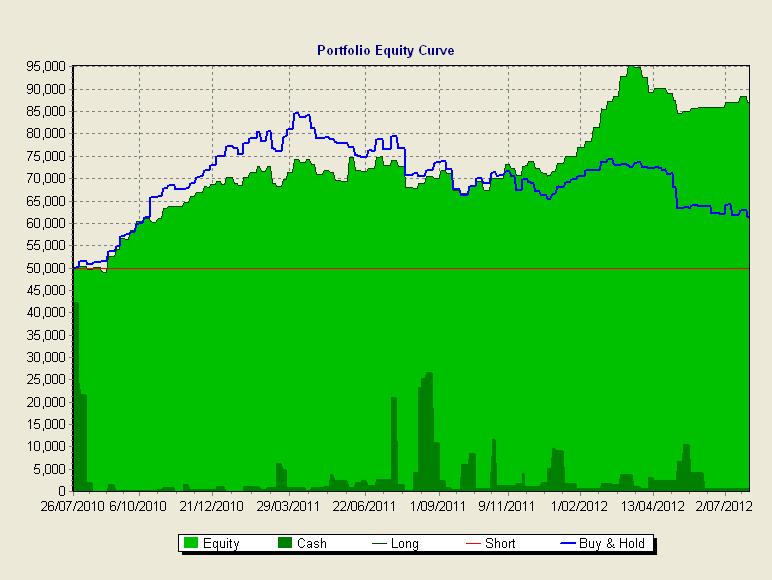
So here are some stats for those that like that sort of thing.
Starting with 50K 2 years ago, the portfolio has grown to 87K.
It’s a long only weekly system that buys and sells on a Monday.
It has a 50% win rate.
It has averaged 32% p.a
Trades the ASX 500 shares only
The worst pullback in equity it has had is 11% (May 2012)
Some Disadvantages are:
You are “in” the market all the time and it can be hard to buy when the market is falling and bad news is all around. (but that’s why it risks small amounts and being in the market can be great for catching sudden rallies, dividends, share offers and the occasional takeover)
You will do more trades because of the pyramiding method, this one did 130 in 2 years, about 10 a month. That can be cut down to around 70 or just 5 a month if you want to risk 1% per trade, you will make more money, but you risk more, that’s the usual pay off the individual trader needs to decide.
Note the blue line on the graph, that is the result if the portfolio bought and held the index of the XAO 500 (the All Ords)
I hope this newsletter gets you thinking to what is possible to achieve. The mechanics of trading is easy, it’s the human elements of anxiety and worry that make it so difficult. The method described above is one way of helping to overcome those concerns.
If you are interested in this sort of material go to the website or sign up for the newsletter if you have not done so already, and please fwd to anyone you may think would find the above interesting.
Until next time
Peter
|