|
Welcome to this newsletter for easy share trading systems
It has been a few weeks since the last letter, as it’s been a busy time for us. I have not forgotten about you all, just busy working away on new projects.
In late October I held a trading course for 40 peoplel, in the beautiful Khedrubje Meditation Centre at Wamberal, followed by another course in November, at a private residence (thanks Michelle) in the Wollongong area, and then a presentation at the Canberra ATAA.
Also…. We have moved into a new office in Terrigal, so its been a bit hectic….lucky I trade a weekly system and don’t need to check the trades every day. Ha!
Speaking of weekly systems it seems that the Course Pyramid System seemed to attract a lot of interest, there are definitely a lot of people disheartened with their superannuation returns, be that industry funds or self managed, or they are looking for a simple safer “lifestyle” way to trade.
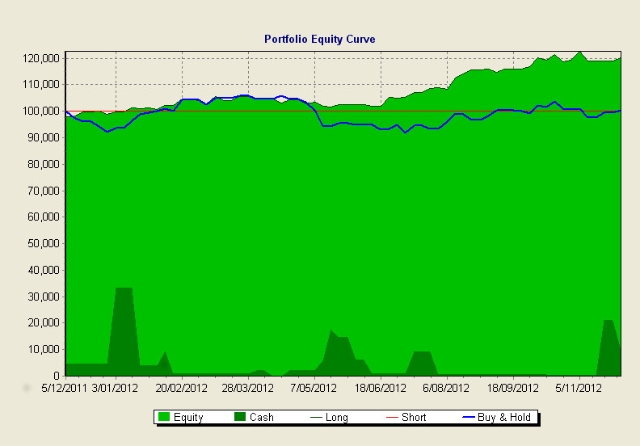
The Course Pyramid system has returned 20% this year on the ASX 200, doing 25 trades and risking 1% per trade. As you can see by the cash level in dark green it’s “in the market” nearly all the time.
I say “in the market” because it’s a question I hear often from fearful traders, wondering if it’s safe to buy yet?
There are variations of this system, (that do better than the graph above) designed to suit the individual trader. The trader can employ Bull Market and Bear Market filters, which I talk about in the courses. Profits are a secondary consideration to your ability to execute and stay calm, if you can’t do that a system that makes more return is useless to you. Better to trade a method that makes 20% p.a and be happy and calm, than tear your hair out. Employing methods to keep you in and out of the market, for low stress and profit, is a great strategy.
The markets continue to be choppy, one thing you can be certain of in this market is uncertainty, but what has really changed? The market always climbs a wall of worry, always, even in good times.
The way not to worry too much is to employ a high probability method, and stick to it.
Lets have a look at the XAO and what it’s been doing this year to date.
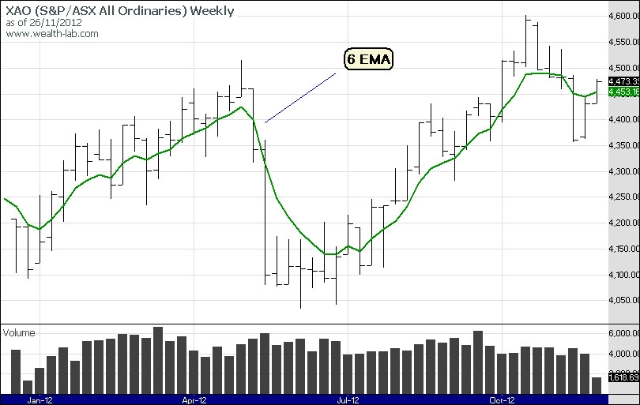
Those of you that attended the courses will recognize this chart and the Weekly 6 EMA. (the same as a 30 day daily)This weekly chart of the XAO the last 12 months shows a choppy ride, any wonder some people have been struggling to trade it without an easy system. When the XAO falls below the 6 EMA, it’s not a sell signal, but a raising of stops signal. So a few weeks ago we would have raised our stops and sold under performers, but the XAO has rallied back up again, so its risk on until it falls again below the 6 EMA. Our method and rules tell us what to do, without second guessing all the time, and getting stressed out by indecision.
That really was a savage pullback in May, but looking at the equity curve in the top chart, it hardly caused a ripple. Why? Because good systems hold strong stocks, and strong stocks tend not to sell off so hard. When the market recovers strong stocks are the first to go up, combine that with good position sizing (buying the optimum amount of shares per trade) and the portfolio performs.
Simple.
I thought I would feature a few stocks this news letter. Stocks that I am holding in my portfolio.
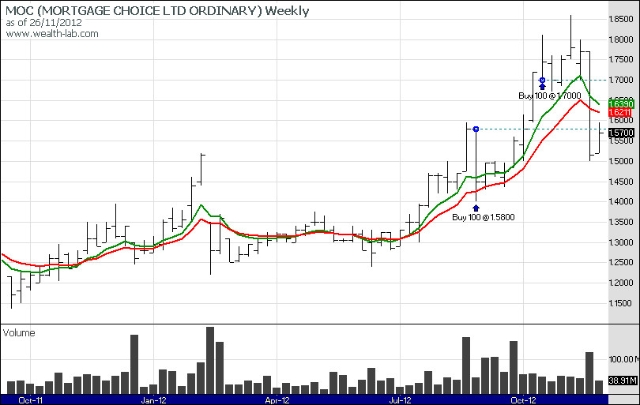
Mortgage choice is a company in the top 500, (XAO) for those interested in some fundamentals it pays a dividend of 8.3% p.a and has a P.E of 10.
It made a 52 week closing high back in August and I added to the rising stock some weeks ago. Now it is moving around with some volatility, but until I get a EMA crossover I will hold the stock and let it play out. Patience is required and the next stock shows you why it is important to wait for your signals before acting.
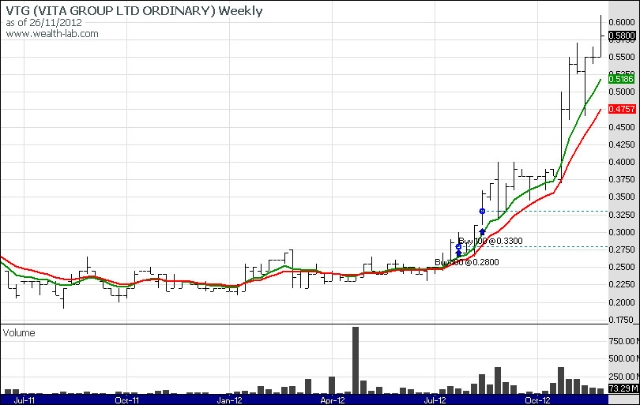
VTG is a small retail company specializing in telecommunications. It pays a dividend yield of 2.6 %
I added to this stock also, and it has not looked back. People often say “why not wait for a pullback before buying a second time?”
My answer is that more often than not the best trades never pull back at the start, if you don’t take the green light when you see it (the buy signal) you miss the trade, then your mind plays games with you as you regret the opportunity. VTG is a good example of not mucking around trying to save a few cents……..
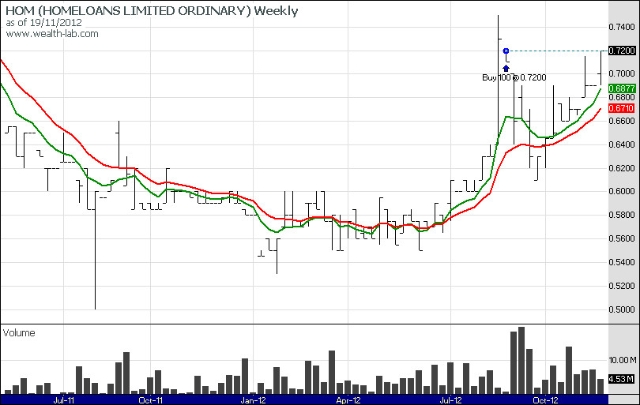
Here is a good example of how pyramiding works. This stock HOM, has not risen enough above the initial buy entry to warrant adding. We only add to strong stocks, unless this one continues up, we just wait for the exit and take a small loss or break even.
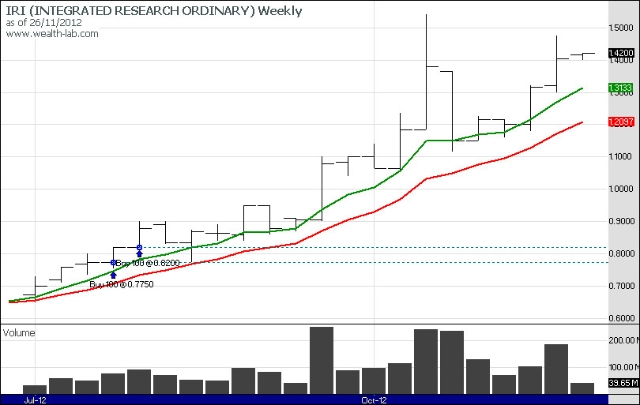
IRI is another one that just never pulled back from the entry. Its hard to know which ones will, so the best option is to position size well and go with the flow.
Next news letter I will feature a few new trades, and we can follow them more regularly. I plan to be more frequent with the newsletters, now things have settled a bit. Until next time....
ZEN QUOTE: IF IT IS NOT NECESSARY TO DO ANYTHING, IT IS NECESSARY TO DO NOTHING.
Peter.
That's all from Pete guys, here come my two cents.
Cale
This email is a bit heavy.
Trading can be a self deluded nightmare of emotions or an exciting and intellectual exercise in making money. So where does it go so wrong?
What is the minuscule difference between falling apart in the markets and keeping your head? Also, does this have anything to do with making money?
It has everything to do with making money.
The difference exists in that space of time "When you get the trade signal and act on your signal". This is where a big part of trading exists, in that space of time. It matters in a way which you might not have not thought about. The expectations you have when putting the trade on, are as important to your happiness about trading, as if your trade makes or loses you money.
Yes, I did say that. The trade will do its own thing, you having an expectation of it will not influence it one little bit.
The entry signal and lack of action.....
That span of time between getting the signal from your trading system (if you don't have one we really need to talk) and confirming the trade with your broker/online platform can be a very short frame of time or a very long one. During this time, emotions come and go, in great flux and often unbidden. It is very easy to imagine at this moment two little cartoon characters on either one of your shoulders arguing the finer points of trading.
"Am I doing the correct thing?"
"Is now the best time?"
"This is a sure thing, I should put more money on it."
"What happens if this one goes south?"
"What if the signal is wrong?"
"I have doubts about the system"
"I don't think this trade will work"
These thoughts might go through your head all in five seconds
I am sure that you can come up with a few more yourself.
Firstly, stop it, you are doing yourself more harm than good by dwelling on these doubts.
You have a system in place for exactly this reason, so you do not have to modify your trading based on your current emotions when signing over your hard fought for money.
When I envision trading on the market and the weekly system that Peter has designed for my lifestyle, I don't plan on screen watching for hours every day. I plan on following the system, letting my expectations go, and spending time with my passion projects and friends/family.
Your passion projects might even be your day job, imagine how great that would be. I would not hesitate to say that I was jealous of you then.
So, in short, put the trades on when you get the signals, let the expectations go, no screen watching and enjoy life.
Sounds easy right? Exactly, that's why it's so hard.
My two cents
Cale
|